|
1. Pig Welfare: Dental Health and Culling Rates; Sorting and Needless Stress
Two recent articles in National Hog
Farmer magazine provide expert analysis of farmers'
approaches to dental health and sorting for farmed
pigs. The articles are from an industry perspective
with emphasis on the financial benefits from improving
dental and sorting practices, but may also have significant
implications for pig welfare.
DENTAL HEALTH: Wayne Johnson, a veterinarian and student at the University of Illinois, writes extensively about the state of dental health among farmed sows and how it relates to culling. Johnson found that among sows who were culled for any reason, "about 85% showed significant dental lesions presumed to cause pain or local tissue reaction." Johnson then conducted a follow-up study with live sows whom he tracked and found that "Sows with bad molars were 17 times as likely to be culled as those with good molars." Johnson will now study how farmed sows interact with their cages and stalls, using video evidence to analyze "bar-biting" and other issues related to bad teeth. Summarizing his findings, Johnson says, "We know that culling rate and mortality rate are too high, and the longevity is too short in our industry. It appears that bad teeth are associated with higher culling rates."
SORTING: Dr. Harold Gonyou at the
University of Guelph (Ontario, Canada), says that
sorting pigs by weight, common practice at large farms,
is a "waste of time" and increases aggression. Gonyou
says that housing pigs with other similarly-sized
pigs increases competition and "social stress that
happens within a pen." He recommends that pig farmers
seeking "performance gains" not sort the animals at
all to avoid the stress, or deliberately mix pigs
of different sizes. According to Gonyou, "We found
that if we put the aggressive pigs together in a pen
with just other aggressive pigs, then their productivity
was depressed. If we put all the non-aggressive pigs
together in a pen, they had good productivity. And,
if there was a mixture of aggressive and non-aggressive
pigs in a pen, they had good productivity as well."

1. "Sow Dentistry 101," National Hog Farmer, 1/15/06
http://nationalhogfarmer.com/mag/farming_sow_dentistry/
2. "Skip the Sorting," National Hog Farmer, 1/15/06
http://nationalhogfarmer.com/mag/farming_skip_sorting/
2. Smithfield Foods, Workers' Rights, and Pig Slaughterhouse Line Speeds
Smithfield Foods, the world's largest
pig slaughterer, is facing a growing threat of unionization
among workers who complain about abusive management
and illegal employment practices. According to the
New York Times, workers at a Smithfield slaughterhouse
in North Carolina have provided "a steady stream of
complaints about bullying managers, the line speed
and the many injuries to hands, arms and shoulders."
According to the union, line speeds force employees
to "process" too many animals per shift: "On each
processing line on the kill floor, a hog passes about
every three and a half seconds, translating into about
1,000 hogs an hour, 8,000 a shift." The North Carolina
slaughterhouse employs 5,500 workers and kills 32,000
pigs daily.
The complaints against Smithfield go further
than increased line speeds, however, including physical
intimidation and harassment of employees involved
with unions. In 2004, the US National Labor Relations
Board (NLRB) upheld a court ruling that said Smithfield
had prevented a fair election among workers regarding
whether or not to unionize. The NLRB concurred with
the ruling that Smithfield had "prevented a fair election
by illegally intimidating, firing, threatening and
spying on workers (and) also had a union supporter
beaten up the night of the vote count."
"Union Takes New Tack in Organizing Effort at Pork-Processing Plant," NY Times, 2/13/06
http://www.nytimes.com/2006/02/13/national/13labor.html (Registration)
3. North American Deer Slaughter Industry Continues Despite CWD Concerns
Farming of captive deer (or cervids)
may be growing in the US despite the risk of Chronic
Wasting Disease (CWD) from farmed animals commingling
with wild deer populations. The North American Deer
Farmers Association (NADFA) boasts that it represents
"the owners of over 75,000 cervid livestock" in 43
US states and several Canadian provinces. According
to a separate source, "Pennsylvania and Wisconsin
each have about 1,000 deer farms; Ohio, 800; and New
York, 500. Texas has about 712 licensed breeders owning
812 facilities and 40,000 cervids." According to an
NADFA member survey, deer farmed in North America
are distributed according to species as follows: Axis
- 9.2%; Fallow - 23.7%; Red - 30.4%; Sika - 21.1%;
Whitetail - 26.9%; Wapiti - 4.6%; and Other - 3%.
According to an attorney with the West Virginia Deer Farmers Association, "Potential markets for deer farmers include venison from elk, red deer and fallow deer; velvet from the antlers of elk and red deer; antler art; breeding stock; hunting preserves; tourism with menageries; and sale of deer attractants for hunting uses." In West Virginia, however, which currently has 45 deer farms, farmers and hunters are arguing over the importance of the industry and the potentially increased risk of spreading CWD. According to a retired wildlife professor (and bow hunter), "The more CWD is found on deer farms, the more the public turns against them... And in no state does the economic benefit from deer farming come close to the economic value of the wild deer herd to citizens."
Similar concerns have reportedly prompted 17 US states to ban deer farms, but are being downplayed by farmers in West Virginia. They are asking that the industry be regulated by the state Department of Agriculture rather than the Department of Natural Resources, which has proposed "cost-prohibitive" measures such as double-fencing. Opponents say that the agriculture department will provide insufficient oversight when the risk is largely to wild deer populations. In Wisconsin, an outbreak of CWD in 2002 contributed to an estimated decrease of one-third of the farmed deer in the state (11,000 animals) three years later, although the number of farms declined only slightly.
1. "Proposed Rule on Deer Farming Cost
Prohibitive," West Virginia Gazette, 2/6/06
http://www.wvgazettemail.com/section//200602052
2. "State's Deer Farms Pose a Threat to Wild Herds,"
West Virginia Gazette, 2/10/06
http://www.wvgazettemail.com/section//2006020913
3. About the North American Deer Farmers Association
http://www.nadefa.org/aboutnadefa.html
4. "State Reports Nearly 700 Licensed Deer and Elk
Farms," Duluth Superior / AP, 2/12/06
http://www.duluthsuperior.com/mld/duluthsuperior/news/politics/13856139.htm
4. Farmed Animal Statistics: USDA "Production" and Consumption Projections
The US Department of Agriculture's (USDA)
Office of the Chief Economist has released its annual
report providing 10-year projections for US farm production
and per capita consumption. The report projects primarily
economic data relating to value of agricultural products,
consumer prices, exports, etc. It also provides details
about farmed animal welfare, however, including the
projected "production" and "inventory" of the species
of animals most regularly slaughtered for food in
the US. We have summarized the most relevant findings
below and provided a link to the full report at the
end of this section.
10-Year Farmed Animal Slaughter and "Inventory" Projections

- Overall: "Livestock
sector projections over the baseline period reflect
increasing production, strong domestic demand, and
strengthening exports for meat… The trend toward
larger livestock systems continues throughout the
baseline period. Production of all meats slows in
the second half of the projections, reflecting higher
feed costs as more corn is used in the production
of ethanol."
- Poultry: "Poultry
production continues to rise, but less rapidly than
during the 1990s due to the maturity of domestic
demand and slower export growth." Poultry slaughter
is measured in pounds rather than individual birds,
and "production" is projected to grow from 35.6
billion pounds in 2005 to 43.6 billion pounds in
2015 (+23%).
- Pigs: "Pork production
grows slowly as the coordinated/integrated industrial
structure continues to dampen the traditional U.S.
hog cycle." The farmed pig "inventory" was 61 million
in 2005 and is projected to grow to 66 million in
2015 (+8%).
- Cows for Slaughter:
"Cattle herds are expected to increase from cyclical
lows near 95 million head in 2004 to near 103 million
head (+8%) at the end of the projections (2015),
with much of the gain occurring in the next several
years."
- Cows for Milk: "Milk
cow numbers are expected to decline after 2006 at
a relatively slow pace." Cows for milk production
currently number about 9.0 million (2005), but the
herd size is projected to decline slightly to 8.7
million cows in 2015.
10-Year Per Capita Consumption Projections
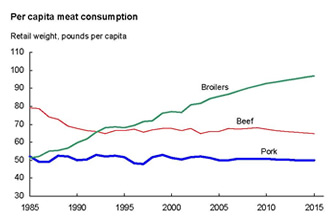
- Overall: "Annual
per capita consumption of red meats and poultry
grows from 220 pounds in 2005 to 231 pounds in 2015
(+ 5%). U.S. consumers buy more meat, but spend
a smaller proportion of disposable income for these
purchases, continuing a long-term trend. Over the
next 10 years, consumer meat expenditures decline
from about 2 percent to 1.3 percent of disposable
income. Poultry expenditures continue to increase
as a share of consumer spending on meats."
- Poultry: Per capita
chicken consumption is projected to increase from
85.3 to 96.8 pounds (+13%) from 2005 to 2015, respectively.
Per capita turkey consumption is projected to increase
slightly from 16.4 to 16.8 pounds (+2%) over the
same period. Per capita egg consumption is expected
to increase from 255 eggs in 2005 to 261 eggs in
2015 (+2%).
- Pigs: Per capita
"pork" consumption is projected to hold relatively
constant from 2005 to 2015, increasing very slightly
from 49.7 pounds to 49.9 pounds, respectively.
- Cows: Per capita
"beef" consumption is projected to decline slightly
from 65.9 pounds in 2005 to 64.8 pounds in 2015
(-2%). "Per capita consumption of fluid milk is
expected to decline slowly," but by an unspecified
amount.
1. "USDA Agricultural Baseline Projections to 2015," USDA / ERS, 2/10/06
http://www.ers.usda.gov/Publications/OCE061/
2. Also see: USDA Baseline Data Delivery System for "Livestock and Dairy"
http://www.ers.usda.gov/db/baseline/default.asp?ERSTab=3&VIEW=Dairy
3. Also see: Archived USDA baseline projection reports, produced annually since 1997
http://www.ers.usda.gov/Data/SDP/view.asp?f=baseline/
5.
Other Items of Interest
"EP Supports Better Welfare
for Chickens," European Parliament, 2/14/06
The European Parliament adopted a report on February
14 that calls for strengthening legislation to protect
"broiler" chickens beyond those proposed by the European
Commission. The report calls for stronger minimum
standards for all 25 EU Member States, with specific
concerns including "stocking densities, the condition
of parent birds, genetic acceleration of the growth
rate of birds and environmental enrichment."
http://tinyurl.com/cnjds
(europarl.eu.int)
Also see: http://www.eurogroupanimalwelfare.org/press75.htm
"Humane Society Asks Tyson to Investigate
Freezing Live Birds," NWAonline.net, 2/10/06
An employee at a Tyson Foods contract farm witnessed
the company keeping sick and slow-growing chickens
in a freezer until they die, "a process that could
take several days." The complaint comes in a letter
to Tyson management from the Humane Society of the
United States, which also alleges that the contractor's
management knew of the problem and took no action.
Tyson, which kills 2.2 billion chickens a year, said
it would investigate the complaint and that the practice,
if true, would be inconsistent with the company's
position on animal welfare.
http://www.nwaonline.net/articles/2006/02/10/business/01tyson.txt
"2006 Farm Income Forecast," USDA / ERS, 2/10/06
The annual farm income forecast provided by the US Department of Agriculture predicts that farm revenue will drop a significant 23% in 2006 to $56 billion, down from $73 billion in 2005. "The value of production is forecast to be down $2.9 billion for livestock, a little over 2 percent… Value of livestock production is forecast to be $124.1 billion in 2006. Cash receipts from all livestock are forecast to exceed $100 billion for the fourth time over the past 5 years, but to fall short of the 2005 record by $2.6 billion."
http://www.ers.usda.gov/Features/FarmIncome/2006/February/
Also see: http://www.ers.usda.gov/Briefing/FarmIncome/nationalestimates.htm#livestock

|

![[missing header image]](../images/faw_pigs-brwn.jpg)
![[missing header image]](../images/newsletter_ico.jpg)